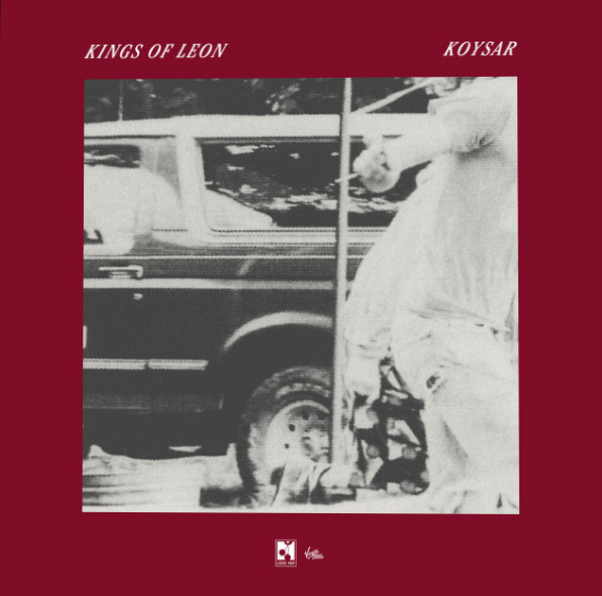
There comes a point in a rock band’s career when looking backward stops being an exercise in nostalgia and becomes a way of understanding the present. Kings of Leon have reached that point with KOYSAR, a song whose unusual title conceals an uncomplicated childhood instruction: Kick Off Your Shoes and Run. Released on October 16, 2026, the single finds the Tennessee quartet considering the distance between the freedom they remember from childhood and the responsibilities that now define their adult lives. Rather than dramatizing that contrast, they approach it with a warmth that feels increasingly central to their recent work.
The song arrives ahead of O My Beloved, the band’s tenth studio album, scheduled for November 6 through Love Tap Records and Virgin Music. Following My Whole World and Cold Blue Dawn, KOYSAR offers another indication of the record’s personal direction. The forthcoming album is Kings of Leon’s first entirely self-produced studio project, a significant development for musicians whose relationship with producers has helped shape several distinct periods of their career. This time, the emphasis appears to be less on reinvention than on examining the experiences that made the band possible.
Caleb Followill’s inspiration came from repeatedly singing the phrase that eventually supplied the song’s title. The words brought back memories of a childhood when running outside required neither planning nor justification. That recollection becomes more complicated when viewed through parenthood. The Followill brothers and their cousin Matthew are no longer simply young musicians escaping the restrictions of their upbringing. They have families of their own, and the experiences they once took for granted have become things they hope to preserve for another generation.
That shift gives KOYSAR its emotional foundation. Childhood freedom is easy to romanticize because memory rarely preserves its ordinary inconveniences with the same intensity as its pleasures. What survives is the sensation of possibility, the belief that an afternoon could extend indefinitely and that the world beyond the front door belonged entirely to whoever was willing to explore it. Followill’s songwriting draws on that feeling without suggesting that adulthood must be defined by its disappearance.
Musically, the single follows the more relaxed direction of the band’s recent releases. Its easygoing character marks a considerable distance from the nervous garage-rock energy of their earliest recordings and the monumental choruses that subsequently established them as international festival headliners. Kings of Leon have often been most recognizable when their music carries a certain physical urgency. KOYSAR instead places its emphasis on an inviting, unhurried atmosphere.
That choice is interesting because restraint has not always been the band’s most celebrated quality. Albums such as Only by the Night and Come Around Sundown demonstrated how effectively the group could transform relatively straightforward guitar arrangements into enormous communal experiences. Their commercial success, however, also established expectations that sometimes threatened to narrow their artistic identity. The pressure to deliver another sweeping anthem could make quieter songwriting appear comparatively insignificant.
KOYSAR challenges that assumption. Its central idea is modest, but the emotions surrounding it are not. The song considers how people preserve a sense of hope when the future appears increasingly uncertain. Followill’s perspective does not deny the anxieties of contemporary life. Instead, it places greater importance on the relationships that make those anxieties manageable. There is a difference between pretending everything will improve and deciding that fear should not determine every aspect of daily existence.
The accompanying music video makes that distinction particularly clear. Rather than constructing an elaborate fictional narrative, it follows the band members spending time with their families at a fairground. The setting provides a fitting visual counterpart to the song’s childhood associations. Amusement rides, shared activities, and the ordinary excitement of a family outing become reminders that meaningful experiences do not always require extraordinary circumstances.
There is something revealing about seeing Kings of Leon presented in this environment. Their public identity was once inseparable from youthful volatility, strained family dynamics, and the mythology of rock musicians discovering freedom through excess. The fairground video offers a different image of adulthood, one in which excitement is shared rather than pursued individually. It also brings the band’s longstanding family identity into sharper focus. Their personal connections are no longer simply part of their origin story. They have become an important subject of the music itself.
The song’s emphasis on togetherness could easily become sentimental, and this is where its simplicity presents a limitation. Optimism built around family and childhood memories is familiar territory, particularly for established musicians reflecting on the passage of time. KOYSAR does not appear interested in challenging those associations through dramatic musical experimentation or uncomfortable lyrical contradictions. Listeners drawn primarily to the band’s more abrasive instincts may find its gentler outlook less compelling.
Yet demanding perpetual aggression from Kings of Leon would overlook how substantially their circumstances have changed. The musicians who recorded Youth and Young Manhood were confronting an entirely different set of possibilities from those facing them today. Their early urgency emerged from youth, ambition, and the desire to escape familiar limitations. Reproducing that attitude indefinitely would risk turning a once convincing artistic identity into an exercise in imitation.
What makes KOYSAR meaningful is the recognition that growing older does not necessarily require abandoning the instincts that once made life exciting. The invitation to run can be understood as an encouragement to remain curious, spontaneous, and emotionally available, even when responsibility has become unavoidable. The song’s optimism may be straightforward, but its perspective is shaped by experiences that the band’s younger members could not have fully understood.
As a preview of O My Beloved, KOYSAR suggests that Kings of Leon are increasingly interested in documenting the lives they have built rather than competing with the cultural impact of their earlier recordings. It is not their most confrontational artistic statement, nor does it attempt to be. Its appeal rests on a quieter conviction: the freedom worth remembering from childhood may be the same freedom adults have a responsibility to make possible for others.
Listen to Kings of Leon – KOYSAR