The Goo Goo Dolls have spent decades writing about people who are never quite where they want to be. Sometimes the distance is geographical, sometimes emotional, and occasionally it exists entirely between the life someone has imagined and the one unfolding around them. That persistent sense of displacement has shaped much of the band’s most recognizable work, from the restless romanticism of Name to the overwhelming emotional exposure of Iris. Postcards from Paradise introduces a title that fits naturally within this tradition. It suggests a message arriving from somewhere desirable, but it also raises a less comfortable possibility: perhaps paradise is easier to describe from a distance than to recognize while living inside it.
For John Rzeznik, the relationship between memory and emotional expectation has long provided fertile songwriting territory. His strongest compositions rarely depend on complicated narratives. Instead, they isolate a recognizable feeling and allow it to develop through melodic repetition, direct language, and a gradual accumulation of intensity. That approach helped transform the Goo Goo Dolls from a rough-edged alternative rock band into one of the defining melodic rock acts of the late 1990s. Their commercial breakthrough was substantial, but it also established a musical identity that has followed them through every subsequent creative decision.
The band’s early recordings were considerably more abrasive than the polished material that eventually brought them international recognition. Punk energy, distorted guitars, and an occasionally unruly approach to performance reflected their origins in Buffalo’s independent rock scene. As their songwriting developed, melody became increasingly central, although the transition was never as abrupt as retrospective accounts sometimes suggest. The tension between raw instrumentation and emotionally accessible writing had existed for years. Their breakthrough came when those elements began reinforcing one another with greater consistency.
That history matters when considering a title such as Postcards from Paradise. The phrase belongs to a tradition of American pop-rock imagery in which roads, destinations, departures, and remembered places become expressions of emotional uncertainty. A postcard is a particularly revealing object. It compresses an experience into a carefully selected image and a few words, offering someone elsewhere a simplified version of reality. Whatever loneliness, boredom, or disappointment exists beyond the frame remains invisible.
As a songwriting premise, that contradiction offers more interesting possibilities than straightforward nostalgia. Paradise can represent an actual location, an idealized relationship, or a version of the past that has become more attractive through selective memory. The difficulty lies in distinguishing genuine happiness from the stories people construct about it. That uncertainty is closely aligned with Rzeznik’s established interest in romantic longing, particularly his ability to portray desire as something that can be both sustaining and destructive.
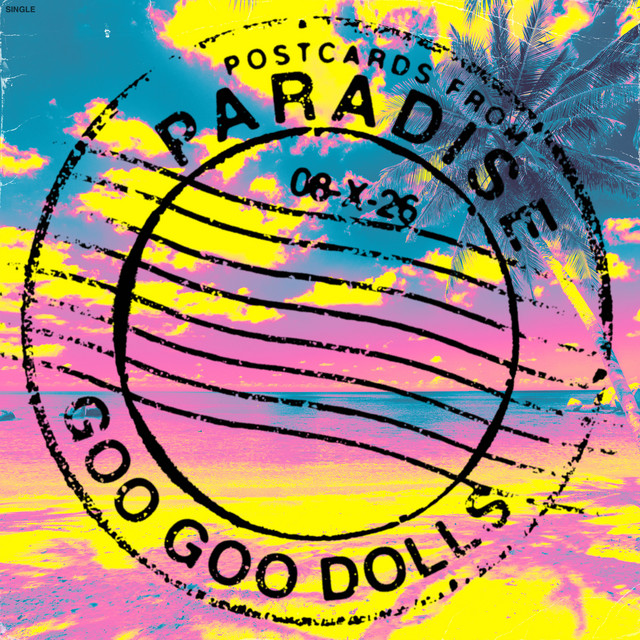
The most important detail about the October 16, 2026 release is that Postcards from Paradise is not an entirely new composition. The song originated with British alternative rock band Flesh for Lulu, appearing on their 1987 album Long Live the New Flesh. The Goo Goo Dolls recorded their own version in 2010, when it appeared as bonus material associated with Something for the Rest of Us. Its renewed release introduces that recording to a contemporary audience as the first single from Borrowed, a forthcoming collection of cover songs.
This history changes how the recording should be understood. Rather than representing a new stage in Rzeznik’s songwriting, it demonstrates the band’s relationship with an earlier generation of alternative rock. Flesh for Lulu emerged from the British post-punk environment, developing a sound that combined gothic undertones, melodic accessibility, and the romantic theatricality of the 1980s. Their music occupied a fascinating position between underground sensibilities and the increasingly polished ambitions of alternative pop.
The Goo Goo Dolls approach the material from a different tradition. Their interpretation places the song within the muscular, guitar-centered sound that defined much of their work around 2010. Rzeznik’s acoustic and electric guitar parts provide the arrangement’s melodic foundation, while Robby Takac’s bass and Mike Malinin’s drumming establish a conventional rock framework. Produced by Tim Palmer, the recording reflects a period when the band favored polished, carefully balanced arrangements without completely abandoning its earlier alternative-rock identity.
Rzeznik’s vocal delivery also changes the character of the composition. His recognizable grain and slightly strained melodic phrasing bring a sense of direct emotional urgency to material originally associated with the more stylized atmosphere of British alternative rock. The result illustrates how a cover can acquire a different personality without requiring a radical rearrangement. The song’s essential structure remains recognizable, but its emotional presentation belongs unmistakably to the Goo Goo Dolls.
There is a limitation to the recording’s renewed appearance. Because the performance dates from 2010, it cannot reasonably be presented as evidence of the band’s current creative development. Listeners expecting a newly recorded statement may find the release more retrospective than its contemporary presentation initially suggests. Its value lies instead in revealing a connection between different periods of alternative rock history.
That connection gives Borrowed an interesting premise. Cover albums can become predictable exercises in musical admiration, particularly when established artists select familiar songs and reproduce them with minimal interpretive ambition. The more compelling approach is to reveal something about the performers through the material they choose. Postcards from Paradise suggests that the Goo Goo Dolls recognize a musical kinship with the melodic, emotionally restless alternative rock that preceded their commercial breakthrough.
The song’s imagery reinforces that connection. Its vision of paradise is inseparable from romantic dependency, suggesting a place that exists primarily through another person’s presence. The narrator’s longing carries an almost physical urgency, turning ordinary separation into a condition of emotional paralysis. Such exaggerated romantic vulnerability became a defining feature of alternative rock across several generations, although different performers expressed it through markedly different musical languages.
What makes this recording worth revisiting is not the suggestion that the Goo Goo Dolls have discovered an entirely new direction. It is the opportunity to hear an established band acknowledge one of the traditions that helped make its own musical identity possible. The group’s interpretation retains the original song’s romantic instability while giving it the more immediate melodic character associated with Rzeznik’s performances.
Postcards from Paradise ultimately works best as a conversation across time. A song born in the British alternative scene of the 1980s found another life through an American rock band in 2010 and now returns as part of a retrospective project in 2026. Its continued relevance rests on a familiar contradiction: the places people imagine as perfect often become meaningful because of someone who is no longer there. The Goo Goo Dolls do not resolve that tension. Their recording simply gives it another voice, reminding listeners that some forms of romantic uncertainty survive every change in musical fashion.
Listen to The Goo Goo Dolls — Postcards from Paradise